Tell us about the job
Takes about a minute. No obligation.
Homes in Twin Falls County, ID run heat about nine months a year, from September through May. A boiler cycling through that kind of demand accumulates wear on its burner, heat exchanger, and ignition components in ways that do not announce themselves until something stops working. By the time a homeowner calls, the failed part is often the last link in a chain that was shortening across multiple seasons. A contractor quoting a repair here has to decide whether the component that failed is the whole problem or the symptom of adjacent components that are close behind it.
Boilers in houses like these carry years of sediment, scale, and corrosion that only show up once a contractor opens the system. Half the homes in Twin Falls County, Idaho were built in 1982 or earlier (2020-2024 ACS 5-year). That depth of service history changes what the repair actually is: a heat exchanger that looks intact from outside may have scaling that blocks flow, and a relief valve that tests fine under no load may seat wrong under pressure. The parts question matters too, because components for systems running in housing this old are not always in current production, and a contractor has to price and source them before a repair scope is real.
The Parts of a Boiler a Contractor Checks First
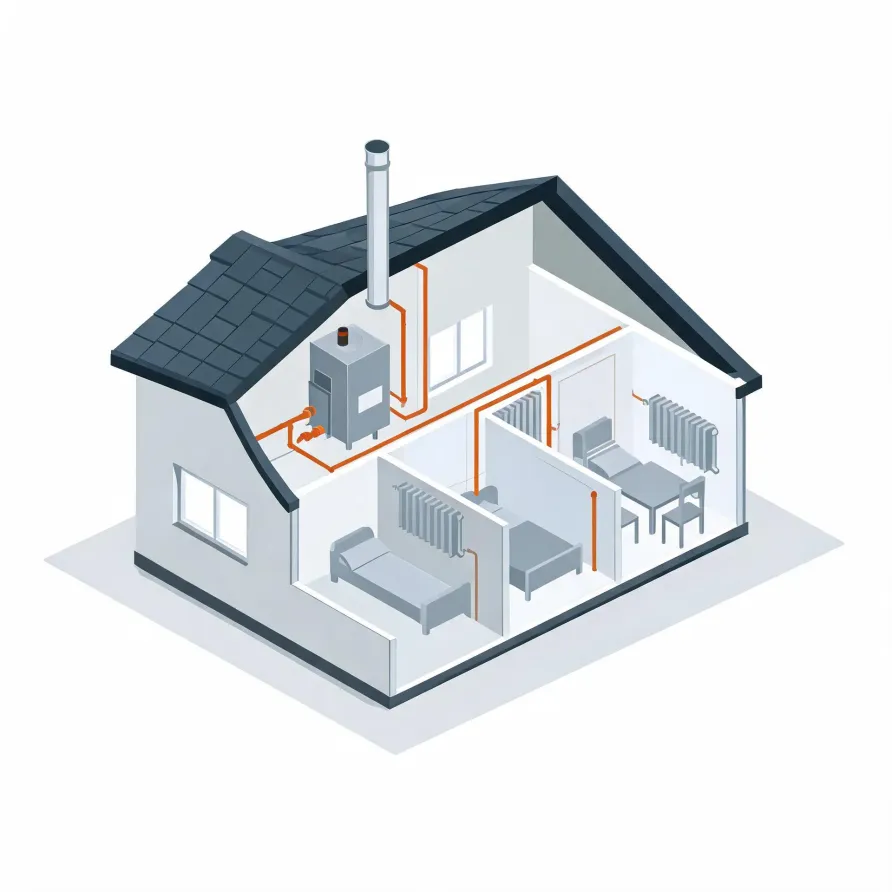
The boiler itself sits in the basement or mechanical room and is the piece a contractor goes to first. It heats water and pushes it out through the system. When heat stops reaching the rooms, or pressure readings are off, the boiler's burner, heat exchanger, or pressure relief valve is usually where the diagnosis starts.
From the boiler, pipes carry hot water to radiators or baseboard units positioned along the walls of each room. The circulator pump, mounted on those supply lines, drives the water through the loop. When a room stays cold while others are warm, the pump or the zone valves controlling flow to that section are what a contractor examines.
The drawing shows a typical boiler layout, and a licensed contractor determines which components and conditions apply to your specific home.
Find a contractor in Twin Falls CountyTwin Falls County, by the numbers
58 severe weather events were recorded in Twin Falls County, Idaho between 2015 and 2024.
NOAA National Centers for Environmental Information, Storm Events Database, bulk CSV export, events 2015-01-01 through 2024-12-31.Half the homes in Twin Falls County, Idaho were built in 1982 or earlier (2020-2024 ACS 5-year).
U.S. Census Bureau, 2020-2024 American Community Survey 5-Year EstimatesTwin Falls County, Idaho holds 36,429 housing units (2020-2024 ACS 5-year).
U.S. Census Bureau, 2020-2024 American Community Survey 5-Year EstimatesOwners occupy 70.5% of the occupied homes in Twin Falls County, Idaho (2020-2024 ACS 5-year).
U.S. Census Bureau, 2020-2024 American Community Survey 5-Year EstimatesBoiler & HVAC Repair Rules on Record for Twin Falls County, Idaho1 sourced standards and codes
Licensing Rules for HVAC Work in Twin Falls County, Idaho
Idaho requires a state certificate of competency for heating, ventilation and air conditioning work: it is unlawful to engage in the business, trade or practice without passing the examination and holding the certificate.
Weather Stress on Boilers in Twin Falls County
Extreme weather events put direct pressure on heating systems, driving the kind of thermal cycling, demand spikes, and component wear that lead to breakdowns. How much of that pressure a boiler faces depends on where it sits, which is why this data is specific to Twin Falls County.
58 severe weather events, 2015–2024. Source: NOAA National Centers for Environmental Information, Storm Events Database.