Tell us about the job
Takes about a minute. No obligation.
Sizing a boiler for Idaho County starts with understanding what the equipment is actually asked to carry. Homes in Idaho County, ID run heat about ten months a year, from September through June. A burner cycling through that span accumulates wear on the heat exchanger, the ignition system, and the pressure relief components at a pace that leaves little room for an undersized unit to hide. A contractor quoting a replacement here runs a load calculation against the actual envelope of the house, because a boiler spec that works in a milder region will be chasing its setpoint all winter and wearing out the parts that matter most.
Ductwork laid down for one generation of heating equipment carries assumptions about static pressure, trunk sizing, and branch runs that a newer boiler may not share. Half the homes in Idaho County, Idaho were built in 1977 or earlier (2020-2024 ACS 5-year). A contractor quoting a boiler installation here needs to walk the distribution system before pricing the unit, because whether the existing runs will move heat the way the new equipment is designed to deliver it is the question the job turns on. The electrical side follows the same logic: service capacity installed for an older load profile gets measured, not assumed.
What Goes Into a Boiler Installation
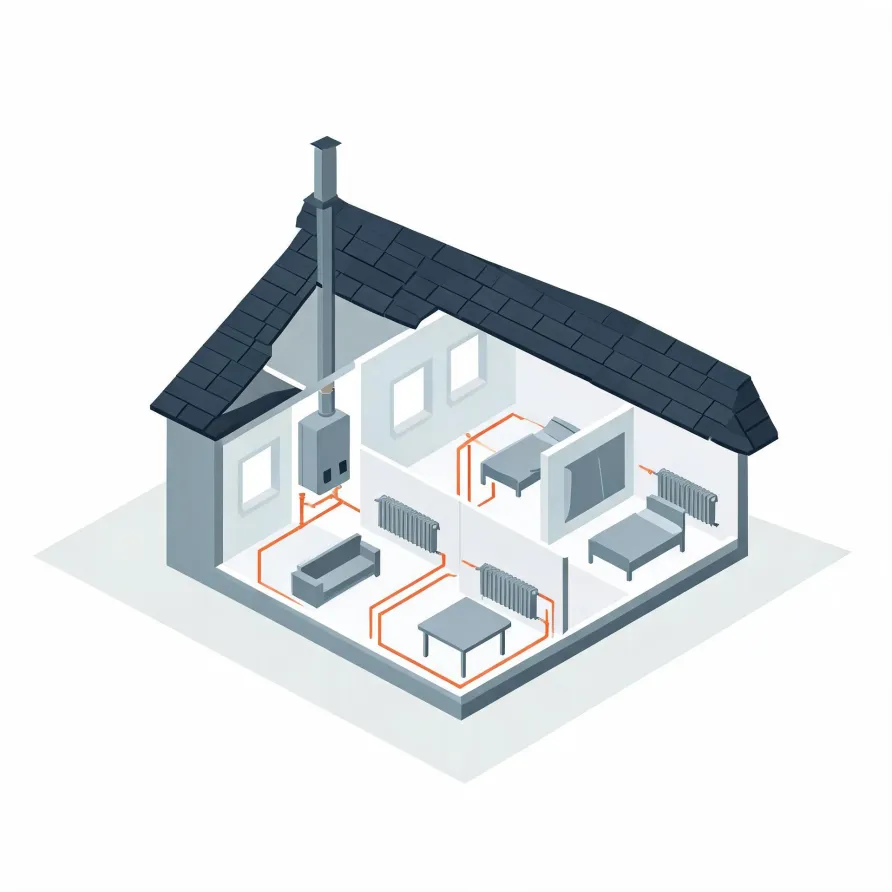
The boiler itself sits in the mechanical room or utility space, usually in a basement or closet. It heats water and sends it through the system on demand. A new installation also includes the expansion tank, which mounts close to the boiler and keeps pressure steady as water temperature rises.
The circulator pump moves heated water from the boiler through the supply pipes and back through the return lines. Thermostatic controls and zone valves mount along those pipes and at the boiler, dividing the house into separately controlled areas. Radiators or baseboard units sit in each room and release the heat carried from the boiler.
The drawing shows a typical boiler layout, and a licensed contractor determines exactly what applies to your home.
Find a contractor in Idaho CountyIdaho County by the Numbers
100 severe weather events were recorded in Idaho County, Idaho between 2015 and 2024.
NOAA National Centers for Environmental Information, Storm Events Database, bulk CSV export, events 2015-01-01 through 2024-12-31.Half the homes in Idaho County, Idaho were built in 1977 or earlier (2020-2024 ACS 5-year).
U.S. Census Bureau, 2020-2024 American Community Survey 5-Year EstimatesIdaho County, Idaho holds 8,903 housing units (2020-2024 ACS 5-year).
U.S. Census Bureau, 2020-2024 American Community Survey 5-Year EstimatesOwners occupy 80.9% of the occupied homes in Idaho County, Idaho (2020-2024 ACS 5-year).
U.S. Census Bureau, 2020-2024 American Community Survey 5-Year EstimatesCodes & Standards Governing Boiler Installation in Idaho County, Idaho1 sourced rules and standards
Licensing Rules for HVAC Work in Idaho County, Idaho
Idaho requires a state certificate of competency for heating, ventilation and air conditioning work: it is unlawful to engage in the business, trade or practice without passing the examination and holding the certificate.
Severe Weather Events in Idaho County
Idaho County's climate puts real demands on heating equipment. A boiler that holds up through hard winters and weather swings is a local question, not a general one.
100 severe weather events, 2015–2024. Source: NOAA National Centers for Environmental Information, Storm Events Database.